
Your Controller Is Leaving. Now What?
Learn how to protect your accounting operations, prevent disruptions, and transition smoothly with the right systems, processes, and staffing options in place.
Your controller just announced they’re leaving.
Maybe they’ve been with you for years, and they know every nuance of your books, every vendor relationship, every system quirk. They’ve kept things running quietly and reliably.
But now, you’re staring at the gap they’ll leave behind and wondering what comes next.
This isn’t just a personnel change. It’s a moment of financial vulnerability and opportunity. Especially for relationship-driven companies, where complexity moves faster than most back offices can keep up.
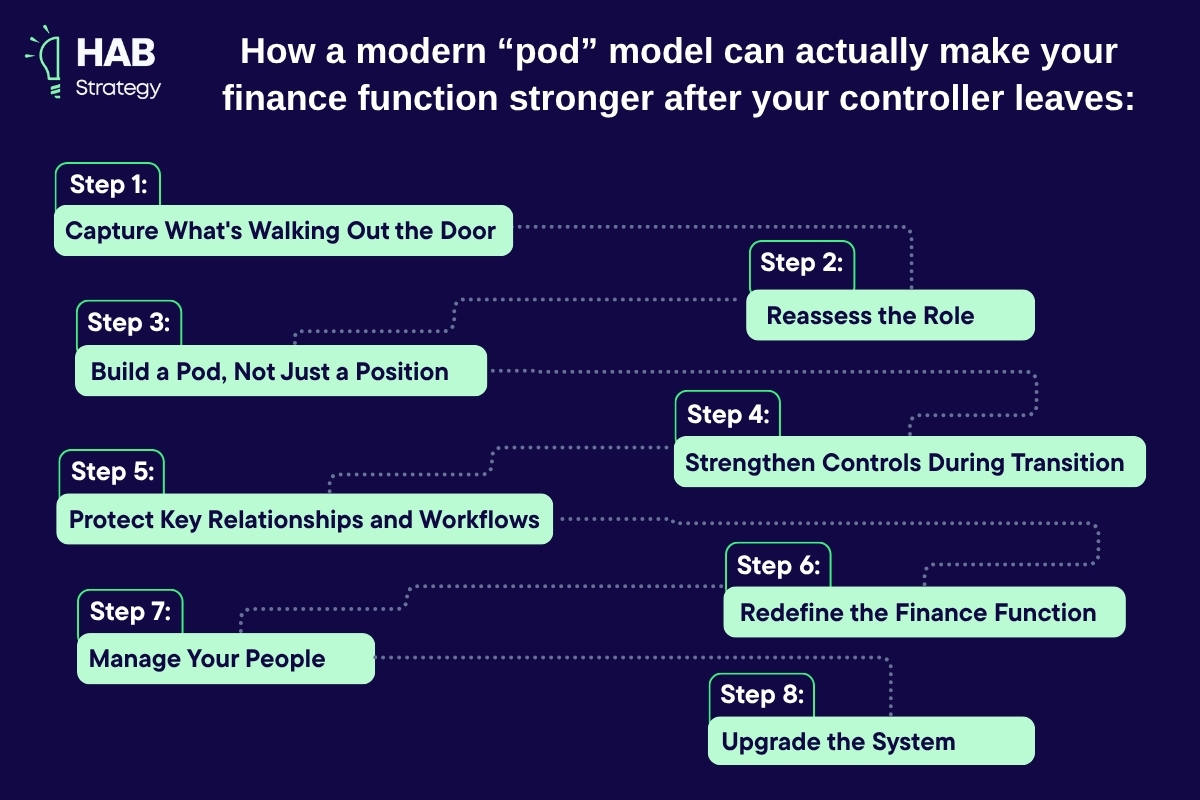
Let’s unpack what really needs to happen when your controller steps away and how a modern “pod” model can actually make your finance function stronger than ever.
Step 1: Capture What’s Walking Out the Door
Controllers carry a lot of institutional memory: processes, reconciliation methods, internal checklists, and the logic behind historical accounting decisions.
Before they leave:
- Document every recurring task, right from monthly closes to tax prep.
- Map out systems, integrations, and access points.
- Record process gaps, manual workarounds, and dependencies.
In dynamic businesses, even one undocumented reconciliation method or API connection between ledgers can cause headaches later. Knowledge capture protects continuity.
Step 2: Evaluate the Real Scope of the Role
Controllers often do far more than what’s written in their job description. They manage payables, oversee the company budget, communicate with auditors, and monitor compliance. When they leave, more roles are needed to manage their workload just to keep your day-to-day operations functioning at the same level.
But ask yourself: does your business still need a “traditional” controller? Do you need multiple new hires? Or is there another way?
In modern finance operations, especially those straddling U.S. and Canadian compliance, one person can’t be the expert in everything. That’s not a skill gap, that’s a capacity gap.
This is where progressive finance leaders are rethinking the model.
Step 3: Build a Pod, Not Just a Position
At HAB Strategy, we offer our clients the pod team structure, which includes a bigger, specialized group with deep knowledge that collectively performs various finance functions as a unit. This means that you get broader capability without bloated overhead.
Think of it like a financial ecosystem:
- Senior Accountant: Enters the data, handles vendors payments, does the reconciling to ensure accuracy
- Controller: owns data oversight, reviews, tax compliance, and reporting accuracy.
- CFO: Handles cash management, long-term planning, and business profit growth.
This pod delivers the same output, if not more, than a single full-time controller, for roughly the same cost.
Step 4: Strengthen Controls During Transition
A gap in finance is the perfect moment to re-examine internal controls:
- Are there any segregation-of-duties, or could one person effectively commit and then hide fraud?
- Are there single points of failure (like one person handling approvals and payments)?
- Is there a plan B if there is an unexpected emergency or illness
If your outgoing controller managed most of these manually, it’s an opportunity to upgrade. This can include the introduction of better technology, shifting to thinking strategically, and trying new approaches.
Your next phase should not be “person-dependent.”
Step 5: Protect Key Relationships and Workflows
Controllers are often the connective tissue between internal teams and external partners, such as customers, banks, vendors, and even payroll providers.
Before they exit:
- Audit their contact list and relationship map.
- Ensure all critical communications, files, and credentials are shared securely.
- Introduce new points of contact early, ideally from within your new pod team or interim controller service.
Continuity isn’t just about data. It’s about maintaining trust and rhythm with your ecosystem.
Step 6: Use the Moment to Redefine Your Finance Function
This isn’t just about replacement; it’s an opportunity to reinvent.
Maybe your old setup worked, but it was built for a smaller company, a different economy, or different regulations. Now’s your chance to redesign:
- Upgrade roles: separate compliance, FP&A, and accounting into clear functions.
- Add strategic reporting: real-time dashboards that show margin trends and cash forecasts.
- Automate approvals and reconciliation: free up human bandwidth for decision-making.
With the right structure, your finance department shifts from reactive to proactive and goes from just keeping the books to driving the business forward.
Step 7: Don’t Forget the People Equation
When longtime finance leaders leave, teams often feel the shock. Controllers are steady hands that everyone trusts. So, communicate clearly:
- Outline your plan early.
- Involve the team in transition steps.
- Reinforce that finance isn’t losing know-how; it’s actually gaining extra capability.
A transparent transition builds confidence across departments and maintains morale.
Step 8: Think Bigger Than Replacement
If you’re a CFO or founder in a scaling company, here’s the real question:
Why replace one person when you can upgrade the entire system?
The pod model gives you flexibility. When business grows, the pod expands. When complexity increases (when you add new revenue streams or jurisdictions), the pod adjusts.
Instead of relying on one controller juggling ten priorities, you have a distributed team that moves faster, sees broader, and reduces dependency risk.
It’s your chance to move from a traditional, single-threaded finance model to a pod-based system that’s faster, smarter, and better equipped for growth, especially in an economy (and industry) that never stands still.
Because the truth is that the role you’re replacing isn’t just one person. It’s a system.


.svg)
.svg)