
Why the Smartest Founders Are Replacing One Full-Time Hire with a Finance Pod
Discover why forward-thinking founders are replacing a single full-time finance hire with a Finance Pod. Learn how this flexible model provides strategic CFO guidance, accounting expertise, and financial operations support while reducing costs and scaling with your business.
There is a moment in almost every growing company when the founder decides it is time to hire someone to “own the finances.” The spreadsheet has stopped keeping up and investors are asking sharper questions. So, they open a role, write a job description, and start looking for one person to take it all off their plate.
It feels like the responsible move, but it is also one of the most expensive hiring mistakes early-stage companies make, because it solves the wrong shape of the problem.
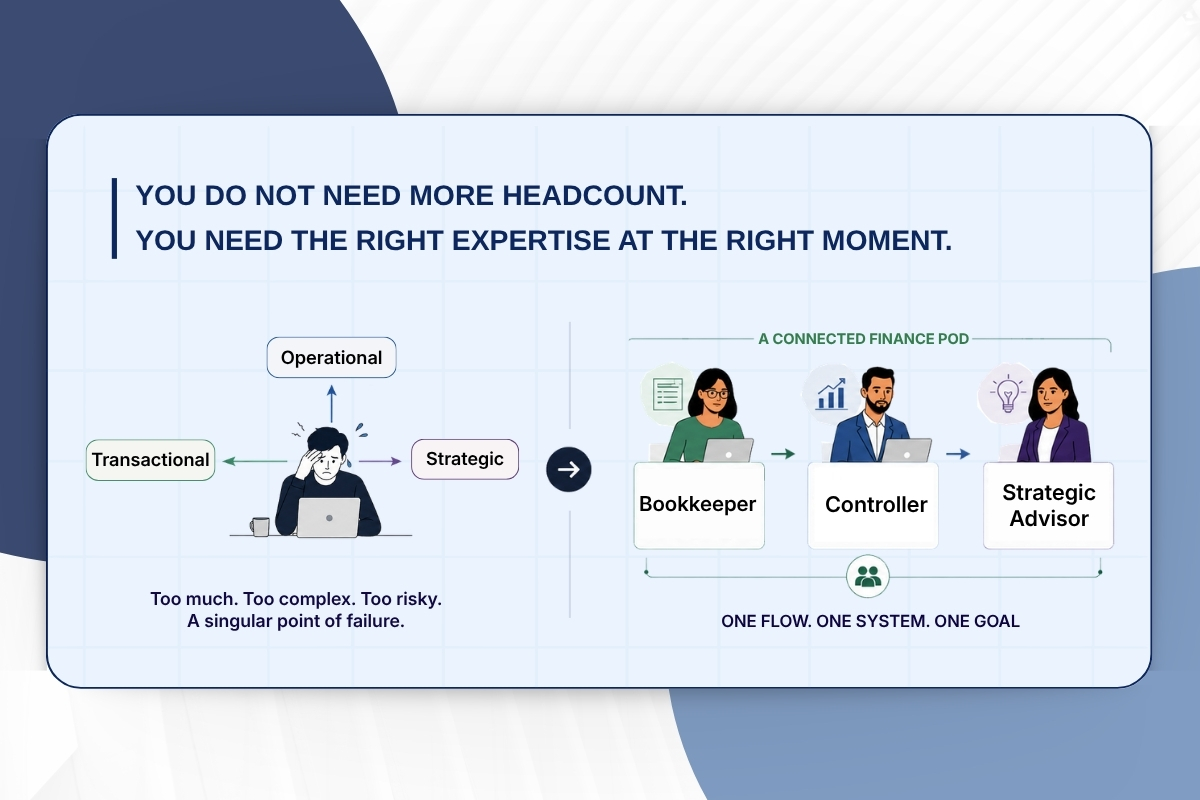
Finance is not a single job; it is a stack of very different jobs pretending to be one. Daily bookkeeping, monthly close, compliance, forecasting, fundraising, pricing strategy: these sit at wildly different skill levels, and asking one person to cover all of them almost guarantees that some are done badly.
When you hire one person to own everything financial, you are not reducing risk. You are concentrating it.
The Compromise Nobody Plans For:
Hire someone senior enough to build a forecast an investor respects, and they are overqualified for the reconciliations you are also paying them to do. Hire someone junior enough to handle the daily work affordably, and the strategic layer never appears. You find that gap at the worst possible time, usually mid-raise, when the books are clean but no forecast holds up under questioning.
And whichever way you compromise, you have built a single point of failure. When that person is away, the numbers stall. When they leave, the knowledge walks out with them, and you are back to square one with a hole in the middle of your operation.
One hire gives you one skill level, one availability window, and one person who can halt your finances by resigning.
What A Pod Does Instead
The founders we work with are increasingly making a different call. Instead of one salaried generalist, they bring in a pod: a bookkeeper for the transactional layer, a controller for the close and the reporting, and a strategic advisor, often a fractional CFO, for the decisions that actually move the business.
The point is not just the three roles. It is that they work as one team. The bookkeeping feeds the reporting; the reporting feeds the strategy. Nothing falls into the gap between roles, because the roles were designed to connect. It is how finance works inside a large company, where no one expects a single hire to be both the clerk and the CFO, delivered to a business that could never justify building the whole department.
Why The Pod Approach Wins
Coverage: Every layer is handled by someone suited to it, so routine work stays cheap and strategic work stays sharp. You stop paying senior rates for data entry, and you stop accepting junior judgment on decisions that deserve better.
Resilience: A pod does not take its vacation all at once, and it does not resign in a single email. Knowledge lives across the team and in shared systems rather than in one head, so the operation keeps running no matter whose calendar is full.
Access: Most early companies do not need a CFO forty hours a week. They need CFO-level judgment for the few decisions each month, where getting it wrong is costly. A pod puts that judgment on call without the full-time salary of an executive who would sit underused most of the time.
And it typically costs less than one strong full-time hire, because you are paying for the finance work the business actually needs, not a fixed salary that is at once too much for the routine work and too little to attract the strategic talent you hoped for.
A pod is not a cheaper version of a finance hire. It is a better-designed one.
The Real Shift
Underneath this is a change in how the sharpest founders build teams. The old instinct was to close every gap by adding a head. The new one is to ask what the business genuinely needs, at what level, and how often, then structure the support around that answer.
Finance is simply where the mismatch between one job title and many distinct jobs shows up first. The goal was never to have someone in the seat. It was always to have the right depth of expertise available at the right moment, without paying for capacity you do not use.
You do not need more headcount. You need the right expertise at the right moment, and a structure built to deliver it.
About the Author
Dave Berney is the Founder of HAB Strategy, a fractional finance team helping startups and growing businesses strengthen financial operations, improve decision-making, and scale with confidence. Through a combination of financial expertise, strategic advisory, and modern technology, HAB Strategy partners with founders to build businesses designed for long-term success.
Ready to build a smarter finance team? Schedule a call with our experts today.


.svg)
.svg)