
The 30 Minute Weekly Finance Routine Every Owner Needs
A practical 30-minute weekly finance routine that helps business owners gain control and financial clarity.
Most business owners do not avoid their finances on purpose, their businesses start to move quickly and as sales conversions take priority, the inevitable happens. Team issues demand attention, client work fills the calendar and the finance function just quietly exists.
Until cash feels tighter than expected or a report does not match what the owner believed was happening. Cue emotional and usually highly reactive responses from all involved.
The truth is, staying financially grounded does not require hours of spreadsheets or deep accounting knowledge. What it requires is a short, consistent routine that keeps owners close enough to the numbers to make good decisions without pulling them into the weeds.
At HAB Strategy, we often tell founders that thirty minutes a week can change the way they experience their business. Not because it solves everything, but because it prevents small issues from turning into large ones.
Here is what that thirty-minute routine looks like and why it works so well.
Why a Weekly Finance Routine Matters
Monthly and quarterly financial reviews are important, but they are too far apart to support fast moving businesses. By the time you see a problem at month end, it has usually been building for weeks.
A weekly routine creates awareness without pressure. It allows you to spot changes early, understand patterns over time, and make adjustments calmly instead of urgently.
More importantly, it changes your relationship with finance. Numbers stop feeling intimidating or distant. They become familiar and that familiarity builds confidence when you know that you won’t be blindsided.
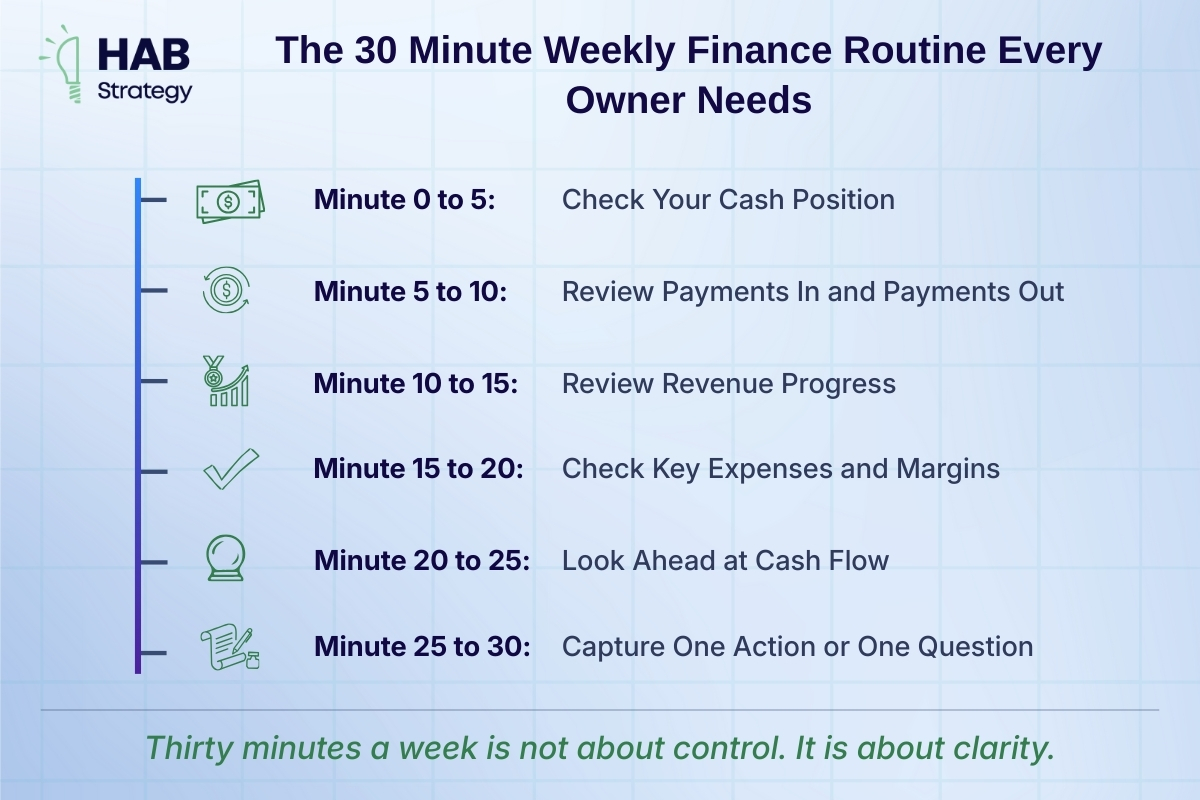
Minute 0 to 5: Check Your Cash Position
Start every week by looking at your cash, not profit or revenue, but cash.
Check your main bank balances and compare them to where they were last week. Ask yourself a few simple questions. Did cash go up or down. Was that expected. Did a large payment come in or go out.
You are not analyzing yet. You are just observing.
This step grounds you in reality. Many owners run businesses based on projected income or past performance. Cash shows you what is actually available today. Staying close to it reduces anxiety and improves decision making.
Minute 5 to 10: Review Payments In and Payments Out
Next, review what happened with money during the week.
On the incoming side, look at customer payments. Were invoices paid on time. Are any balances becoming overdue. Are there customers who consistently delay payment.
Late collections are one of the most common causes of cash stress. Catching them early gives you options. You can follow up sooner, adjust terms, or plan around delays instead of reacting at the last minute.
On the outgoing side, scan expenses. You are not reviewing every line item. You are looking for changes. New subscriptions. Larger vendor bills. One-time expenses that may repeat.
Five minutes of weekly awareness prevents hours of cleanup later.
Minute 10 to 15: Review Revenue Progress
Now turn your attention to revenue.
Compare where you are this month to where you expected to be. Are you on track. Ahead. Behind.
If you track weekly sales, bookings, or billings, review those numbers. Look for patterns instead of perfection.
This step is not about judgment; it is about visibility.
When owners wait until month end to look at revenue, the story is already written. Weekly checks allow you to adjust sales activity, marketing focus, or pricing conversations while there is still time to influence the outcome.
Minute 15 to 20: Check Key Expenses and Margins
Choose two or three cost areas that matter most to your business. For some companies, this is payroll. For others, it is marketing spend, contractor costs, or inventory.
Look at how those costs are trending compared to revenue. Are they stable. Are they increasing faster than sales. Are they aligned with what the business is producing.
You are building intuition here, not reports.
Over time, this weekly glance helps you understand your margin drivers. You start to recognize when costs feel healthy and when something needs attention.
This awareness is what allows owners to protect margins without panic.
Minute 20 to 25: Look Ahead at Cash Flow
This is one of the most valuable parts of the routine.
Instead of looking backward, look forward.
Review what payments are expected over the next two to three weeks. Review what bills are due in the same period and notice any gaps.
This step turns uncertainty into planning. When you know what is coming, you can make choices early. You can delay spending, follow up on receivables, or move money between accounts calmly instead of urgently.
Owners who look ahead weekly rarely experience sudden cash crunches. They may face tight periods, but they face them prepared.
Minute 25 to 30: Capture One Action or One Question
End the routine by writing down one thing.
One action to take or one question to explore.
It could be following up on an invoice, asking your finance team about a cost increase, or scheduling a deeper review next week, it does not need to be big.
This final step is what connects awareness to progress. It ensures the routine leads to movement, not just observation.
Why This Routine Actually Works
This routine works because it is short enough to be sustainable.
It does not require perfect data or deep accounting knowledge, but it requires attention and consistency.
Over time, patterns emerge naturally. You start to understand what normal looks like for your business. You notice changes faster and decisions feel easier because they are based on regular touchpoints instead of rushed reviews.
At HAB Strategy, we see owners who adopt this routine become more confident and more proactive.
How This Fits Into a Bigger Finance Strategy
This weekly routine does not replace monthly reporting, forecasting, or advisory support. It strengthens them.
Weekly awareness leads to better monthly conversations. Monthly clarity supports better quarterly planning and quarterly planning supports stronger long-term strategy.
When owners stay connected to their numbers, finance becomes a guide instead of a stress point.
Common Mistakes to Avoid
Some owners turn this routine into a full audit. That is not the goal. Keep it light and focused.
Others skip weeks when things feel busy. That is when the routine matters most.
Consistency matters more than depth. Thirty minutes every week beats three hours once a quarter.
You do not need to become a finance expert to run a healthy business. What you need is a rhythm that keeps you close enough to the numbers to make smart decisions.
Thirty minutes a week is not about control. It is about clarity.
At HAB Strategy, we help owners build systems and routines that support growth without adding stress. A simple weekly finance habit is often the first step toward a calmer, more confident business.
Consistency beats complexity every time.
Start your 30-minute finance routine—talk to a financial expert today.


.svg)
.svg)