
How to Set Up Clean Financial Systems Across Multiple Entities So Tax Time Is Easier Every Year
Learn how to organize clean financial systems across multiple business entities to simplify bookkeeping, improve reporting, and make tax season easier every year.
Operating multiple entities is often a natural outcome of growth, because it allows businesses to separate risk, structure operations, and manage different lines of activity more effectively. However, from a financial perspective, multiple entities introduce complexity that must be managed deliberately. The structure itself is not the problem, but the absence of consistent systems underneath it often is.
Many businesses find that tax time becomes difficult not because the rules are unclear, but because the underlying financial records across entities do not align. What should be a straightforward process turns into reconciliation, correction, and rework. This usually stems from how transactions are handled throughout the year rather than at the point of filing.
The first requirement is clear separation between entities.
Each entity should operate as its own financial unit, with its own bank accounts, records, and reporting. While this seems basic, the breakdown often occurs when funds are moved informally to manage short-term needs. One entity may pay expenses on behalf of another, or cash may be transferred without clear documentation. Over time, this makes it difficult to determine where revenue belongs and which entity is actually bearing costs. Every movement of funds should have a defined purpose and be recorded accordingly so that financial statements remain reliable.
Consistency in accounting practices across entities is equally important.
In many cases, different entities are maintained with varying levels of detail, different expense classifications, or inconsistent reporting timelines. This creates friction when reviewing performance or preparing for tax filings. Standardizing the chart of accounts, reporting cadence, and level of detail across all entities allows for comparability and ensures that the financial information can be relied upon without significant adjustments.
Intercompany transactions require structured handling.
It is common for entities to share resources such as administrative support, technology, or operational services. Without clear agreements and consistent pricing, these transactions are often recorded inconsistently or not at all. This leads to misallocation of income and expenses, which can distort profitability and create challenges during tax review. Treating intercompany activity as formal transactions, supported by documentation and reasonable terms, ensures that each entity reflects its actual economic activity.
Visibility across the entire structure is another critical element.
Reviewing each entity in isolation may suggest that individual businesses are performing adequately, but it does not provide a complete picture. In some cases, one entity may be supporting another without it being immediately apparent. Consolidated reporting allows owners to understand overall performance and assess whether the structure is functioning as intended. This becomes particularly important when preparing tax filings that must align across multiple entities.
Cash management becomes more complex as the number of entities increases.
Funds are often distributed across different accounts, which can create situations where one entity has excess cash while another faces short-term constraints. Moving funds without structure can lead to confusion around how transactions should be recorded. A disciplined approach to cash management, where transfers are documented and aligned with the purpose of each entity, helps maintain both flexibility and clarity.
Expense allocation is another area that requires attention.
Shared costs such as rent, software subscriptions, and administrative overhead must be allocated across entities in a consistent and reasonable manner. When allocation is done arbitrarily or based on convenience, it distorts financial results and makes it difficult to support the numbers if reviewed. Establishing a clear methodology and applying it consistently ensures that financial statements remain accurate and defensible.
Documentation underpins all of these systems.
Intercompany agreements, allocation methods, and supporting records should be clearly maintained and accessible. Without documentation, even well-structured systems become difficult to justify. This is particularly important when entities operate across different jurisdictions or have distinct functions within the overall structure.
Finally, these systems must be maintained consistently throughout the year.
Reconciliations should be completed regularly, financial statements should be reviewed on a set schedule, and tax reporting should align with accounting records. Financial systems are not tested when they are designed but, but when they are used consistently over time.
Operating multiple entities can provide significant strategic advantages, but only when supported by strong financial systems.
When separation is clear, accounting is consistent, and transactions are properly documented, tax time becomes predictable and manageable. When these elements are missing, complexity builds gradually, and resolving it requires far more effort than maintaining it.
The objective is not to simplify the structure, but to ensure that it functions as intended.
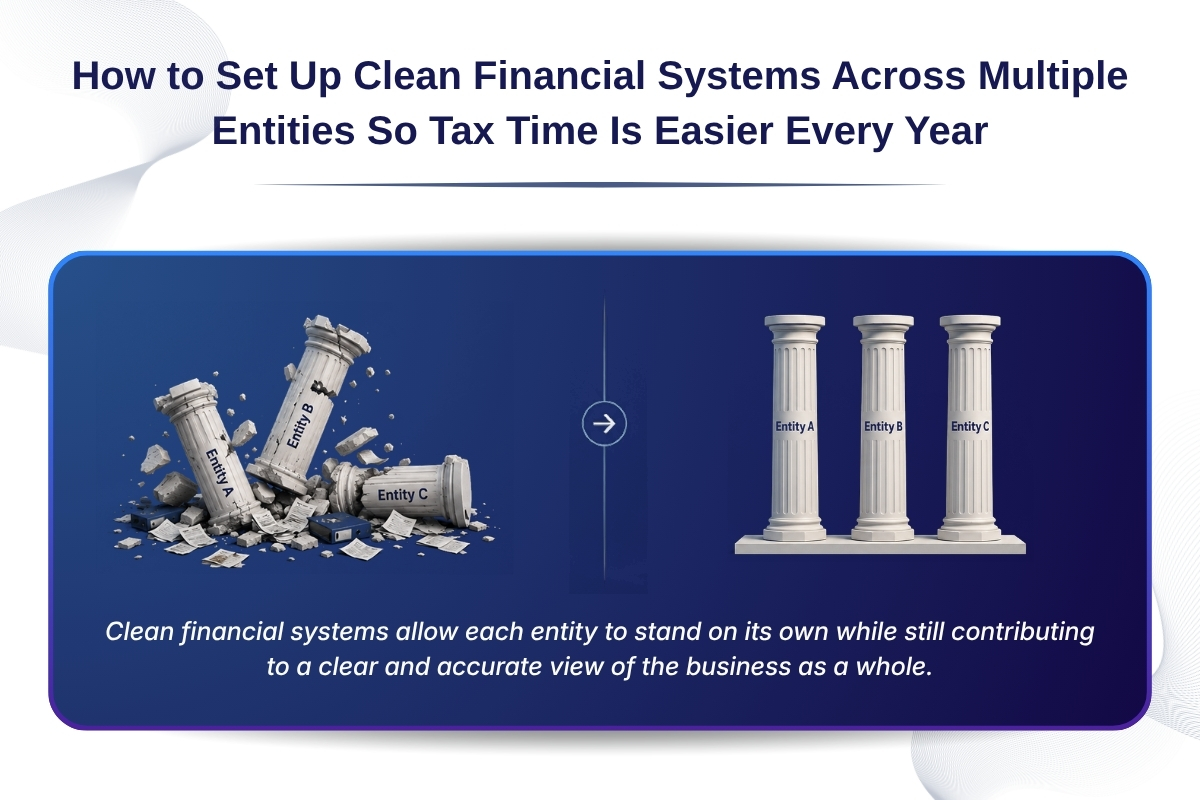
Clean financial systems allow each entity to stand on its own while still contributing to a clear and accurate view of the business as a whole.
Schedule a consultation today to streamline your financial systems and simplify tax preparation across all your business entities.


.svg)
.svg)