
How to Organize Your Records in 2026: Improved Systems That Actually Work
Explore practical ways to organize records in 2026 with updated systems designed to actually work.

Most business owners do not actually have a record problem. What they have is a systems problem that has quietly grown as the business has grown.
Invoices end up in one folder, contracts live in email threads, bank statements are downloaded occasionally when someone remembers, receipts sit on phones, and reports technically exist, but no one is ever fully confident they reflect the whole picture. Over time, this creates friction, doubt, and unnecessary stress.
In 2026, this way of working will no longer be sustainable.
Organized records are not just about compliance or keeping accountants happy. They are about speed, confidence, and control. When your records are clean, structured, and easy to access, decisions become easier to make, cash flow becomes more predictable, audits feel manageable instead of overwhelming, and growth becomes far less chaotic.
At HAB Strategy, we see this pattern repeatedly. Businesses scale faster than their internal systems, and eventually those systems start holding them back. The good news is that fixing this does not require perfection. It requires practical systems that actually work in real businesses.
Step One: Centralize Everything
The first rule of record organization is simple but critical. You need one source of truth.
All financial documents should live in a single, secure, cloud-based system. This includes invoices, bills, contracts, payroll files, tax documents, and bank statements. When documents are scattered across desktops, inboxes, and personal drives, accuracy suffers, and accountability disappears.
A centralized system allows everyone to work from the same information and ensures continuity if team members change or roles shift. It also dramatically reduces the time spent searching for documents during reviews, audits, or decision-making.
Step Two: Create a Clear File Structure
A shared drive alone is not enough. Structure is what makes records usable, scalable, and reliable over time.
Below is a simple file structure that works well for growing businesses:
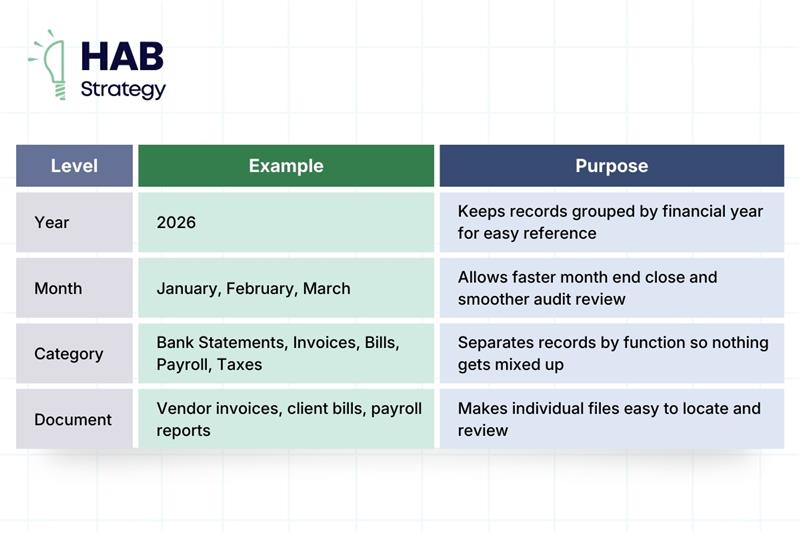
Why this works:
A predictable structure removes decision-making from the process. Anyone on your team, or any external advisor, can find what they need without asking questions or guessing where files might live. Month-end closes faster, reviews run smoother, and the risk of missing documents drops significantly. Good structure saves time every single month, not just at year's end.
Step Three: Standardize Naming Conventions
Files should be named in a way that explains exactly what they are without opening them.
A simple and effective approach is to place the date first, followed by the vendor or client name, and then a short description of the document. For example, “2026 01 Vendor Name Invoice” or “2026 01 Bank Name Statement.”
This may seem like a small detail, but it has a large impact. Clear naming allows for fast searches, reduces duplication, and prevents important documents from being misfiled or overlooked. When naming conventions are consistent, record management becomes far more efficient and far less frustrating.
Step Four: Digitize Everything
Paper slows businesses down more than most people realize.
Receipts get lost, files get misplaced, and access becomes limited to whoever is physically near the document. In 2026, there is no reason to rely on paper for financial records.
Everything should be scanned or uploaded digitally as it is received. Expense receipts, signed agreements, loan documents, and correspondence should all be stored in your central system. This improves accuracy, protects the business if something goes missing, and makes collaboration with your accounting and advisory teams significantly easier.
Step Five: Build Processes Around Records
An organization does not work without habits. Every document should have a clear path that answers three questions: 1- Who uploads it, 2- Where it goes, and 3- When it is reviewed.
For example, invoices might be uploaded weekly, bank statements downloaded monthly, and payroll reports saved after every run. When processes are defined and followed consistently, records stay current, month-end becomes smoother, and year-end feels far less stressful.
Strong processes are what turn good intentions into consistent results.
Step Six: Use Technology That Reduces Manual Work
The right technology makes record organization easier and more reliable.
Modern accounting platforms connect directly to banks, payroll systems, and payment processors, allowing documents to be attached directly to transactions and reports to update automatically. Automation reduces errors, removes repetitive tasks, and ensures records stay current without relying on memory or reminders.
Technology should support your team, not overwhelm it. The goal is simplicity and reliability, not complexity. Take a look at Dext, Gusto, and Acodei to get you started!
Step Seven: Assign Ownership
Every system needs an owner.
Someone must be responsible for maintaining records, checking completeness, and ensuring processes are followed. This does not mean doing all the work personally. It means accountability.
Without ownership, even the best-designed systems eventually fall apart. Clear responsibility keeps records clean regardless of team changes or growth.
Step Eight: Review and Improve Annually
Systems should evolve as the business evolves.
What worked when you had five employees may not work when you have twenty. What worked last year may not work this year. An annual review of record systems allows you to refine structure, improve tools, and close gaps before they become real problems.
The Real Benefit of Organized Records
Clean records do far more than just satisfy accountants; you as a business owner will feel better knowing exactly what records you have and where they are easily located.
They support better decisions, speed up reporting, reduce risk, and give founders confidence. When records are organized, leadership can focus on strategy instead of cleanup, advisors can provide better insights, and growth feels more controlled and intentional.
In 2026, the businesses that succeed will not be the ones working harder. They will be the ones working with clarity. Improved systems are not a nice-to-have. They are a requirement for growth that lasts.
At HAB Strategy, we help businesses build record systems that support where they are going, not where they have been. When records work properly, everything else runs more smoothly. That is how real progress happens.
Ready to organize your records the right way? Get expert guidance today.


.svg)
.svg)