
How Canadian Businesses Can Grow Without Destroying Cash Flow in 2026
Discover practical strategies for Canadian businesses to grow sustainably in 2026 without straining cash flow. Learn how to improve profitability, manage expenses, and maintain financial stability while scaling.
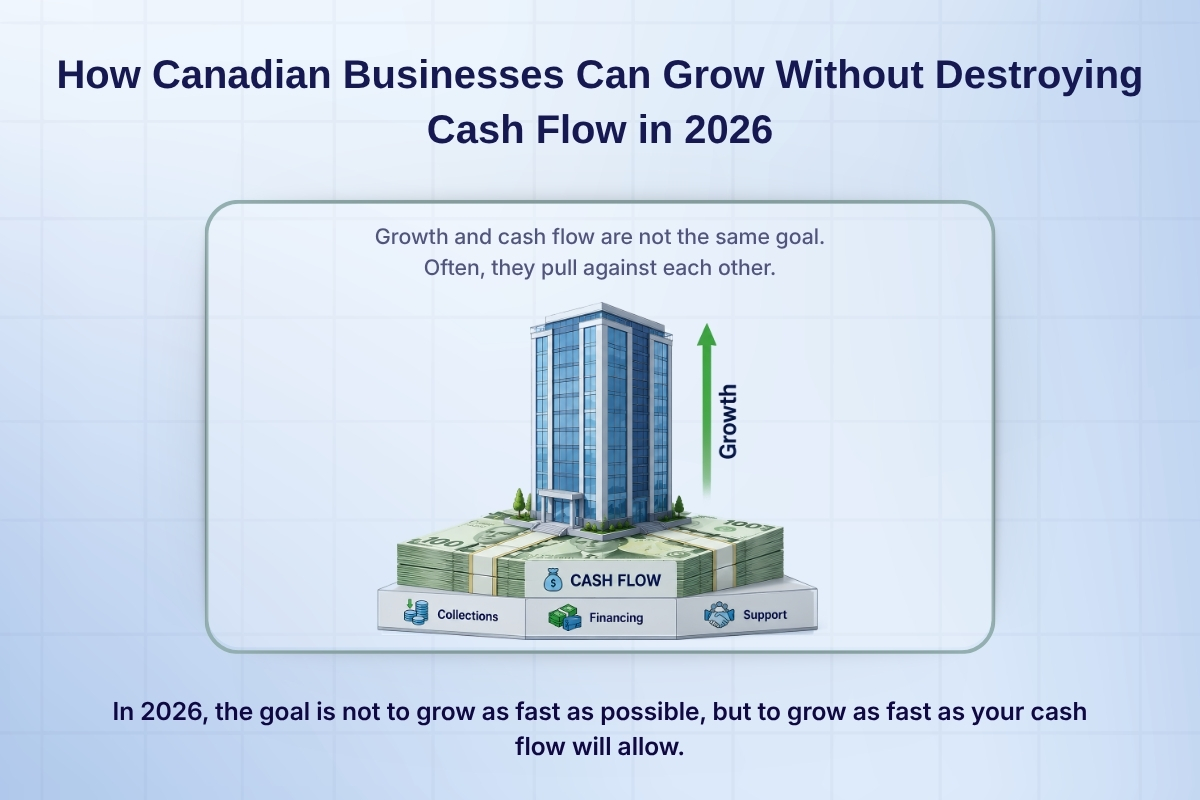
Most Canadian businesses will get into trouble in 2026 because they grew in a way the cash could not support, not because they stopped growing at all.
The conditions make that an easy mistake to make. The Bank of Canada has held its policy rate at 2.25% for a fifth consecutive decision as of June 2026, and its own forecast projects GDP growth of just 1.2% for the year, with unemployment sitting in the 6.5% to 7% range. Borrowing is cheaper than it was two years ago, demand is softer, and the temptation is to chase growth to close the gap.
But survey data shows why that instinct is dangerous. In the Canadian Federation of Independent Business's August 2025 trade-war survey, 63% of small businesses reported higher expenses as a direct result of tariffs, 53% saw reduced profits, and 48% reported lower revenue. Nearly one in five firms absorbing those extra costs said they could not sustain them for more than six months without change.
In an environment like this, growth and cash flow are not the same goal. Often, they pull against each other. The businesses that come out ahead are the ones that learn to tell the difference.
Growth that outruns your cash does not make you bigger. It makes you fragile faster.
Start by treating receivables as the cheapest financing you have.
Every day, between delivering work and collecting payment, is an interest-free loan you are extending to your customer, usually without deciding to. In a year, when more than half of small firms report squeezed profits, that float is rarely free for long, because a customer under pressure pays you last.
Tightening that cycle is the fastest way to fund growth without borrowing. Shorten terms where the relationship allows. Offer a small early-payment discount and measure whether the cash you pull forward is worth more than the discount you give up. And when a customer in a tariff-hit sector starts slowing down, address it at thirty days, not ninety, while recovery is still realistic.
Collecting faster funds growth at zero percent. No lender in Canada beats that rate.
Then claim the government support you already qualify for.
Ottawa and the CRA have put real relief on the table for trade-affected businesses, including tax and remittance deferrals, instalment adjustments, and tariff-refund pathways for eligible importers. The recurring problem is not availability, but awareness, because much of this support goes unclaimed by the firms entitled to it.
Free liquidity that nobody applies for is not support; it is a paperwork gap. Before raising a line of credit, a Canadian business should sit down with its accountant and confirm which deferrals, refunds, and instalment reductions it actually qualifies for. If 2026 income is tracking below 2025, lowering quarterly tax instalments alone can return meaningful cash to the business with no interest cost at all.
The cheapest capital in 2026 is the support you already qualify for and never applied for.
Match the type of financing to the type of need.
When outside financing is genuinely required, the common error is solving a short-term gap with a long-term instrument. A business that takes on multi-year debt to cover a temporary receivables crunch ends up paying for years to fix a ninety-day problem.
Canada has a deep set of tools built for the cash cycle rather than the balance sheet. Accounts receivable financing advances cash against invoices you have already earned. SR&ED tax credits can be financed ahead of the refund. Receivables insurance protects against the customer defaults that become more likely when liquidity tightens across a supply chain. Each of these matches the financing to the timing of the cash, instead of bolting fixed debt onto a temporary need.
Sometimes a slightly higher rate that keeps operations running is cheaper than a low rate that locks you into the wrong structure.
Fund short cycles with short tools. Long debt for a short problem is how solvent companies stall.
Above all, grow against demand you can see, not demand you hope for.
The most expensive growth in 2026 is growth built on the assumption that conditions will improve quickly. With the first joint CUSMA review beginning July 1, 2026, and the CFIB survey showing 79% of owners citing unpredictable trade policy as a barrier to planning, that assumption is unusually risky this year.
Hiring ahead of validated demand, expanding capacity before contracts are signed, and building inventory against forecasts rather than orders all convert flexible cash into fixed cost. In a soft-demand year, fixed costs are exactly what you cannot easily reverse.
The disciplined move is to grow in steps tied to proof. Add the salesperson once the pipeline justifies it. Expand the facility once utilization demands it. Let demand pull the spending, rather than letting the spending chase the demand.
In an uncertain year, the safest growth is the kind your existing customers are already paying for.
These approaches share one idea. Each treats cash flow as the constraint that growth must respect, not an afterthought to be managed once the strain appears.
The Canadian environment has quietly made that distinction expensive. With demand soft, the trade relationship unsettled, and three out of four owners reporting higher stress under the weight of it, the firms that scale will not be the ones with the boldest plans. They will be the ones that grow at the speed their cash can actually sustain.
In 2026, the goal is not to grow as fast as possible but to grow as fast as your cash flow will allow.
Looking to grow your business without cash flow challenges? Schedule a call with our experts today.


.svg)
.svg)