
AI Won’t Replace Your Finance Team, But It Will Expose the Teams That Refuse to Change
Discover why modern founders are turning to AI to transform finance teams, improve efficiency, reduce manual work, and make faster, data-driven decisions without replacing human expertise.
Related reading: Will AI Replace Finance Teams or Make Them More Valuable?
Ask a room of finance professionals whether AI will take their jobs, and you will usually get two reactions: Some go quiet, while others get defensive, but almost nobody is neutral. This is because the question touches something most finance teams would rather not examine too closely, which is how much of the work they do every day actually requires them.
In my opinion, it is the wrong fear. AI is not going to replace finance teams, but it is going to do something almost as unsettling.
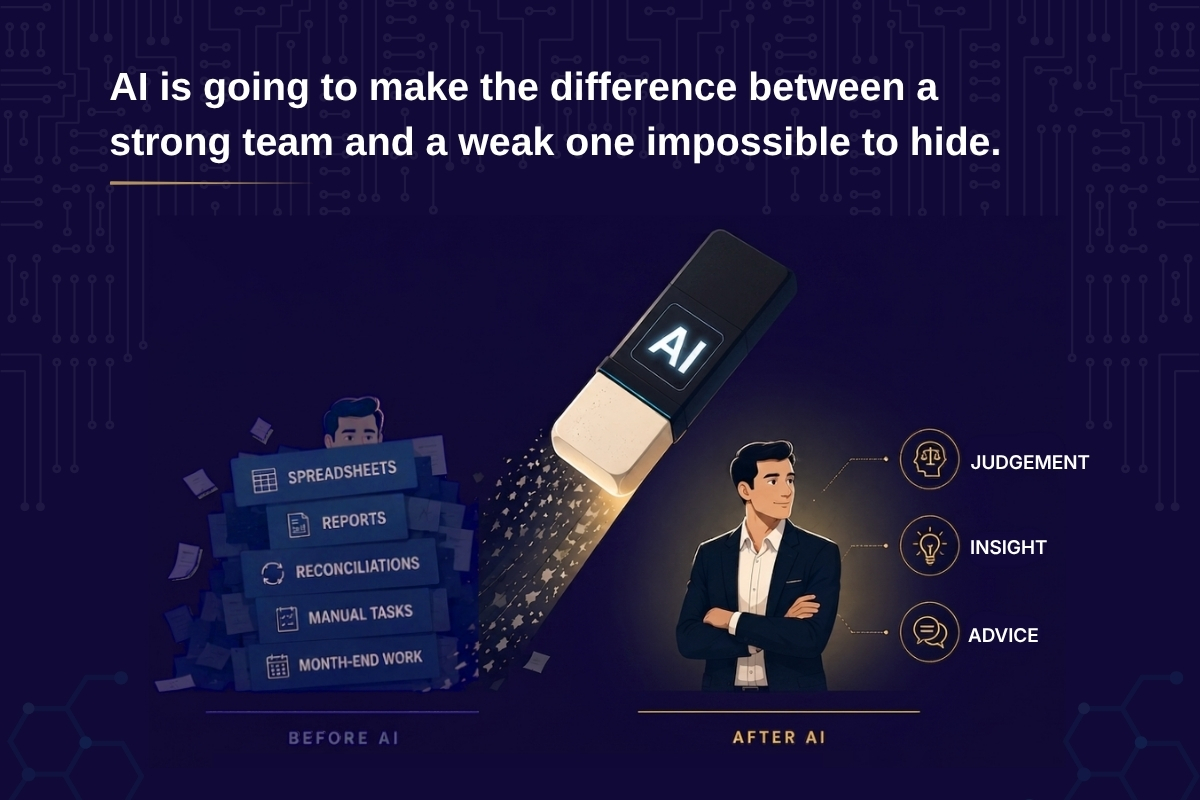
“AI is going to make the difference between a strong team and a weak one impossible to hide.”
For years, that difference could stay comfortably blurred. When clean data, consistent processes, and reliable reporting are still a struggle, the mechanical work of finance absorbs enough time and attention that no one looks too hard at the thinking underneath it. We made the case in an earlier piece that most teams are not behind on AI so much as behind on the financial infrastructure required to use it. Fix that plumbing, automate the manual layer, and there is nowhere left for weak judgment to hide.
AI does not eliminate finance roles. It removes the places weak ones used to hide.
For years, a certain kind of inefficiency was tolerated in finance because it was invisible. Manual work absorbed time that might otherwise have exposed a lack of insight. A team could spend three weeks producing a report and the effort itself looked like value. When the reporting is slow, nobody asks the harder question of whether the thinking behind it is any good.
AI removes that cover. When the mechanical work collapses from weeks to minutes, the only thing left to evaluate is judgment. And judgment is exactly what a lot of finance functions have never been forced to demonstrate.
The first thing AI exposes is who was adding insight and who was adding effort.
Many finance professionals have built their value around producing outputs. They are the person who assembles the board deck, runs the reconciliation, or pulls the monthly numbers together. The work is real, but it is mechanical, and it is precisely the work AI is best at absorbing.
When that happens, the professionals who only ever produced outputs suddenly look exposed, because the output was the whole job. Meanwhile, the professionals who used those outputs to interpret, advise, and challenge become more valuable than ever, because AI has handed them back the hours they used to lose to assembly.
When production becomes free, interpretation becomes the entire job. That divides finance teams instantly.
The second thing it exposes is which teams actually understood their own processes.
AI cannot automate a process that no one can explain. As we noted before, if closing the books requires six spreadsheets, three manual reconciliations, and two people who simply know where the numbers come from, the process itself is the bottleneck.
Teams that documented and standardized their workflows can hand them to AI and gain immediate leverage. Teams that ran on institutional memory and heroics discover that they cannot automate what they never understood well enough to write down. The tool does not create that gap. It reveals it, and it reveals it publicly, because the team next door is suddenly moving three times faster.
You cannot automate a process you never understood. AI turns that quiet weakness into a visible one.
The third thing it exposes is who is willing to change how they work.
This is the real dividing line, and it has almost nothing to do with technology. Adopting AI in finance is not difficult because the tools are hard to use. It is difficult because it asks people to give up the tasks that made them feel needed and to redefine their value around something harder to measure.
Some professionals embrace that. They let the machine take the repetitive work and reinvest their time in analysis, business partnering, and the strategic questions that actually move a company. Others resist, often without saying so directly. They find reasons the tool cannot be trusted, insist their process is too unique to automate, or quietly keep doing the manual work because it is familiar.
The resistance is less about the technology and more about identity. And AI has a way of making that resistance visible, because refusing to change no longer looks cautious. It looks slow.
The teams that struggle with AI are rarely the ones that lack the tools. They are the ones that refuse to change how they work.
The fourth thing it exposes is the gap between looking busy and being valuable.
For a long time, finance has quietly rewarded activity. Long hours, heavy workloads, and packed month-ends were treated as evidence of contribution. AI breaks that equation, because it does the busy work faster and better and never asks for credit.
What remains is the part that was always the real job: understanding what the numbers mean, spotting the risk nobody flagged, and helping leadership make a better decision. Teams that were mostly busy will find they have less to show than they thought. Teams that were genuinely valuable will find they finally have time to prove it.
AI does not measure how hard your finance team works. It reveals how much of that work ever mattered.
None of this means finance professionals should feel threatened. The ones who understand their business, interpret numbers well, and advise leadership with judgment are about to become more valuable, not less. AI hands them leverage that no previous generation of finance leaders ever had.
But it does mean the era of hiding behind manual work is ending. When the mechanical layer disappears, everything underneath it becomes visible: the quality of the data, the discipline of the process, the depth of the judgment, and the willingness of the team to evolve.
That is why AI readiness was never really about technology. It is about whether a finance team has built something worth automating and whether its people are willing to grow into the space the automation creates.
AI will not replace your finance team. It will simply make it obvious which teams were ready to grow and which were only ever keeping busy.
About the Author
Dave Berney is the Founder of HAB Strategy, a fractional finance team helping startups and growing businesses strengthen financial operations, improve decision-making, and scale with confidence. Through a combination of financial expertise, strategic advisory, and modern technology, HAB Strategy partners with founders to build businesses designed for long-term success.
Ready to modernize your finance operations? Schedule a call with our experts today.


.svg)
.svg)